

Route job orders, candidates, interviews, onboarding, and starts through one workflow so recruiters chase fewer updates and fill roles faster with less delay.
Fill Jobs Faster
Connect timekeeping, payroll, billing, and client terms so pay/bill issues are easier to catch before they become margin leaks or collection problems.
Protect Pay/Bill
Keep candidate status, availability, paperwork, communication, and redeployment cues visible so strong workers are not lost to scattered follow-up cycles.
Keep Talent Moving
Give owners and managers clear visibility into job orders, starts, recruiter activity, gross margin, and open issues across every team or branch office.
See Branch Health


Systems Customized to Meet Your Needs
Our systems are developed around the way client job orders, candidates, assignments, pay/bill, and back-office work actually move:
Marketing & Visibility - Clarify target verticals, client offers, job-order paths, referral sources, and service promises.
Lead Capture & Intake - Capture client requirements, roles, shifts, rates, urgency, location, VMS details, and decision-makers.
Quote & Approval Flow - Track pay rates, bill rates, markups, approvals, terms, job changes, invoices, and aging balances.
Scheduling & Placement - Coordinate interviews, offers, starts, assignments, redeployment, and branch capacity by role and urgency.
Recruiting & Onboarding - Give recruiters and coordinators stage views, checklists, notes, screening steps, and start-ready status.
Client & Candidate Communication - Send confirmations, reminders, interview updates, assignment details, onboarding nudges, and pay/bill notices.
Talent & Client History - Track candidates, assignments, client accounts, prior submissions, redeployment options, and relationship notes.
Reviews & Reporting - Monitor job orders, fill speed, starts, gross margin, recruiter activity, compliance gaps, and client service levels.
Top Ten Points of Failure for Staffing Agency Systems
1. Fragmented front-office and back-office data
Owners say job orders, candidates, clients, onboarding, payroll, billing, and reporting often live in separate tools. Duplicate entry creates errors, slower starts, and weak leadership visibility when volume rises.
2. Manual recruiting workflows that cap growth
Managers indicate recruiters lose time to repetitive sourcing, screening, outreach, submissions, interview coordination, and status chasing. The research describes manual recruiting as an operational ceiling when growth depends on more headcount instead of a cleaner process.
3. Slow candidate communication and drop-off
Candidates abandon recruiters when response times lag or communication breaks down. Staffing teams need visible follow-up cues, mobile-friendly steps, and redeployment reminders so strong workers are not lost to faster job platforms.
4. Disconnected timekeeping, payroll, and billing
Owners describe pay and bill problems as expensive quickly. Time data, approvals, client terms, payroll, invoices, and AR need to connect cleanly before small exceptions become margin leaks, disputes, or audit pain.
5. Onboarding paperwork and compliance gaps
Managers indicate onboarding packets, I-9 steps, background checks, required documents, assignment rules, and multi-state tax details can outgrow manual handling. Compliance cannot depend on inbox memory.
6. Poor client job intake and VMS handoffs
Recruiters often receive incomplete job-order details, weak hiring-manager context, or VMS requirements that sit outside the normal workflow. Intake needs to capture rate, urgency, shifts, skills, worksite, and approval rules before sourcing starts.
7. Weak call and communication visibility
Owners say missed calls, after-hours inquiries, and scattered recruiter conversations make coaching and service levels hard to manage. Staffing leaders need one view of outreach, response gaps, and candidate/client touchpoints.
8. Low data quality blocking reporting and AI
Managers indicate old records, duplicate candidates, inconsistent statuses, and scattered sources make reporting unreliable. Data cleanup is also the first requirement before any useful matching or decision support can work.
9. Business development trapped outside the system
Client acquisition is a top priority in the research, yet agency teams often track sales activity in inboxes, spreadsheets, or individual habits. Owners need cleaner visibility into prospects, follow-ups, open reqs, and forecasted starts.
10. Inconsistent processes across branches or acquisitions
Growth exposes workflow differences fast. Owners say one branch may manage submissions, onboarding, calls, and starts differently than another, making service quality, reporting, and training harder to standardize.
Here's How We Address These Issues

Job Order Intake
-
Captures client, role, worksite, urgency, rate, bill terms, shifts, and start date
-
Separates direct hire, temp, temp-to-hire, VMS, and high-volume requests
-
Records hiring-manager notes, must-have skills, screening rules, and approval paths
-
Routes urgent, routine, and hard-to-fill jobs differently
-
Gives recruiters clearer context before sourcing begins

Candidate Pipeline
-
Centralizes candidate status, availability, stage, skills, history, and communication
-
Tracks sourcing, screening, submissions, interviews, offers, starts, and redeployment
-
Shows who needs follow-up before the candidate goes cold
-
Reduces scattered notes across spreadsheets, inboxes, texts, and ATS fields
-
Helps recruiters move qualified people without waiting on manual updates

Onboarding and Compliance
-
Tracks onboarding packets, I-9 steps, background checks, and required documents
-
Shows which candidates are cleared, blocked, waiting, or assignment-ready
-
Connects client requirements, assignment rules, and internal approval steps
-
Reduces last-minute start delays caused by missing paperwork
-
Gives managers better visibility into risk before placement

Pay/Bill Protection
-
Connects timekeeping, approvals, payroll, billing, invoices, and collection status
-
Flags pay rate, bill rate, markup, term, or missing-approval issues earlier
-
Helps office teams catch exceptions before payroll or invoicing runs
-
Supports cleaner margin tracking by client, branch, recruiter, and job type
-
Protects cash flow by reducing avoidable rework and billing delay

Client Service Visibility
-
Shows open job orders, submissions, interviews, starts, and service-level gaps
-
Tracks recruiter activity, call visibility, account follow-up, and client updates
-
Gives branch leaders better coaching data without constant status meetings
-
Helps account teams spot at-risk requisitions and neglected relationships
-
Builds steadier client communication as volume and branch count grow

Growth Backbone
-
Connects business development, lead sources, open reqs, starts, and follow-up
-
Supports branch consistency, recruiter onboarding, SOP use, and manager accountability
-
Keeps the system practical for daily recruiter and back-office work
-
Gives owners visibility across teams without buying unnecessary tools
-
Creates a foundation for more clients, more starts, and stronger reporting

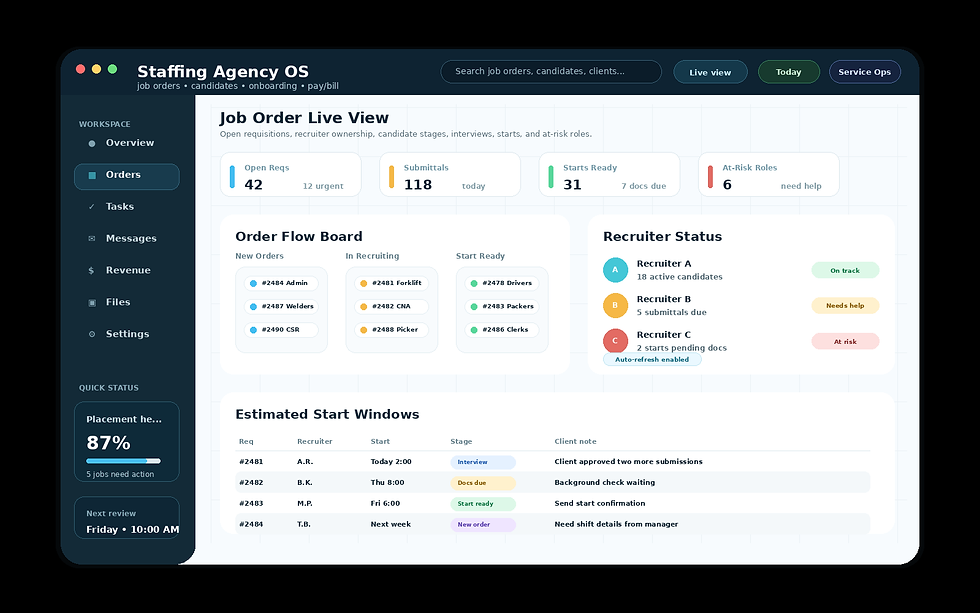
Job Order Live View
A live view for open requisitions, recruiter ownership, candidate stages, interviews, starts, VMS notes, and at-risk roles. Managers can see what needs action without chasing separate spreadsheets or threads.
Candidate & Onboarding View
A control view for candidate status, availability, screening, paperwork, I-9 steps, background checks, assignment readiness, and redeployment cues. The goal is fewer lost candidates and cleaner starts.

Revenue & Expense Intelligence
Gross margin, pay/bill spread, open invoices, payroll exposure, recruiter output, client profitability, and branch performance in one view. Owners can see where growth is healthy and where leakage needs attention.

Made for Staffing Work
Staffing work happens in client calls, recruiter screens, candidate texts, job boards, onboarding packets, payroll runs, and billing follow-up. The system needs to work across desktop and mobile so recruiters, branch leaders, and back-office teams can move work forward without losing the thread.

