

Capture HR changes, time data, deductions, approvals, and notes before each run so payroll starts with fewer gaps, late edits, and manual fixes each run.
Clean Payroll Inputs
Keep cutoff dates, late changes, approvals, and exception queues visible so clients and staff know what must be resolved before payroll runs cleanly.
Control Cutoffs
Track local rules, filings, notices, leave items, ACA, COBRA, and ERISA tasks with clear owners before deadlines become client-facing emergencies.
Protect Compliance
Package leave, ACA, COBRA, ERISA, HR compliance, and onboarding support into repeatable workflows without putting every detail in one person’s head.
Expand Advisory Work


Systems Customized to Meet Your Needs
Our systems are developed around the way client setup, payroll cycles, HR requests, compliance tasks, and advisory work actually move:
Marketing & Visibility - Clarify service offers, advisory packages, target employers, proof points, intake paths, and calls to action.
Lead Capture & Intake - Capture employer size, locations, pay frequency, HR needs, current tools, compliance concerns, and decision-makers.
Quote & Approval Flow - Manage proposals, implementation scope, client approvals, service changes, agreements, invoices, and payment status.
Scheduling & Workload - Organize payroll cycles, implementation milestones, HR requests, filing deadlines, renewals, and account reviews by owner and due date.
Service Execution - Give staff client-specific checklists, cutoff steps, exception queues, document requests, QA checks, and escalation paths.
Client Communication - Send setup reminders, cutoff notices, missing-item requests, payroll status updates, compliance prompts, and resolution summaries.
Client History & Retention - Track payroll cycles, employee counts, HR requests, plan changes, compliance work, issues, and expansion opportunities.
Reviews & Reporting - Track payroll accuracy, turnaround, late inputs, open tickets, workload, client health, advisory revenue, and retention risk.
Top Ten Points of Failure for Payroll / HR Consulting Systems
1. Messy source data before payroll begins
Owners say payroll problems often start upstream, when HR changes, time entries, deductions, approvals, and last-minute notes arrive through email, Slack, spreadsheets, and side conversations. Staff then have to turn scattered inputs into structured payroll data under deadline pressure.
2. Late time inputs and post-cutoff changes
Managers indicate that late or inaccurate time data, missed approvals, and changes after cutoff create rework, off-cycle fixes, and tense client conversations. A payroll run can look controlled until one loose input breaks the cycle.
3. Too many disconnected HR and payroll tools
The research points to severe HR tool sprawl, with overlapping platforms, unused apps, and weak inventories of what the team actually owns or uses. Providers inherit that complexity internally and from clients, then lose time stitching systems together.
4. No clear source of truth across HR, payroll, finance, and the ledger
Practitioners describe control gaps when employee records, labor allocations, payroll profiles, finance entries, and journal cleanup live in separate places. When no record has authority, mistakes travel downstream and take longer to repair.
5. Weak client onboarding and implementation structure
Clients want self-onboarding, signed documents, employee profiles, multi-state tax support, mobile access, and clean data imports. Without a step-by-step setup flow, implementation depends too heavily on staff memory and repeated manual follow-up.
6. Compliance work tracked outside the operating flow
Managers indicate that local rules, state requirements, leave items, ACA, COBRA, ERISA, and related filings can sit beside payroll work rather than inside it. That separation makes ownership, deadlines, and proof harder to manage.
7. Thin performance measurement and weak service visibility
The research shows many payroll teams do not measure accuracy, turnaround, workload, standardization, or service levels consistently. Without live visibility, leadership sees problems after employees complain or clients escalate.
8. Slow support and unclear escalation paths
Owners say payroll support failures damage trust quickly because pay and tax issues are time-sensitive. When errors, filings, employee questions, and client complaints are routed casually, small issues can become account-threatening events.
9. Advisory expansion without repeatable delivery systems
Payroll and HR firms want to add leave, ACA, COBRA, ERISA, onboarding, risk, and HR compliance services. Growth stalls when those services are sold before the firm has clear workflows, owners, documents, and reporting.
10. Too much work held in tribal knowledge
Managers indicate that manual workarounds, individual inboxes, and undocumented exception handling make delivery fragile. When one experienced staff member is unavailable, clients feel the gap through slower answers and inconsistent service.
Here's How We Address These Issues

Source Data Control
-
Captures HR changes, time entries, deductions, approvals, documents, and notes before each payroll run
-
Creates validation steps for missing fields, late inputs, employee changes, and client exceptions
-
Separates routine payroll, urgent corrections, tax questions, and advisory requests
-
Reduces rekeying from email, Slack, spreadsheets, and unstructured notes
-
Gives staff a cleaner starting point before payroll deadlines tighten

Payroll Cycle Visibility
-
Centralizes pay periods, cutoffs, approvals, exception queues, and run status
-
Shows what is ready, missing, late, approved, in review, or completed
-
Connects client reminders, staff ownership, payroll notes, and escalation steps
-
Reduces dependence on spreadsheets, inbox memory, and last-minute check-ins
-
Gives managers a clearer view of payroll risk before pay day

Client Onboarding Flow
-
Guides new clients through setup tasks, employee records, tax details, and permissions
-
Tracks signed agreements, documents, imports, employee access, and go-live readiness
-
Shows which client, staff, or third party owns each open item
-
Builds repeatable implementation steps instead of relying on one person’s memory
-
Helps clients start cleaner with fewer preventable payroll and HR issues

Compliance and Advisory Work
-
Tracks filings, notices, leave items, ACA, COBRA, ERISA, FMLA, and HR compliance tasks
-
Assigns owners, due dates, document needs, and proof of completion
-
Keeps advisory services connected to client records and recurring account work
-
Supports service expansion without scattering work across separate side systems
-
Protects client trust by making sensitive deadlines and responsibilities easier to see

Ticket and Escalation Control
-
Routes payroll errors, tax questions, employee issues, and client requests into clear queues
-
Tracks priority, owner, status, response notes, and resolution history
-
Gives account teams a shared view of open issues before clients have to chase updates
-
Improves handoffs between payroll, HR, finance, and advisory staff
-
Makes support quality easier to manage as client count and service scope grow

Growth and Retention Backbone
-
Connects service delivery, client health, advisory opportunities, and account reviews
-
Tracks payroll accuracy, response time, workload, recurring issues, and client risk
-
Shows where a client may need onboarding help, HR support, compliance work, or cleanup
-
Supports better-fit referrals, retention conversations, and service packaging
-
Creates a system that can support more clients without adding the same amount of labor

Payroll Cycle View
A cycle-control view for pay periods, cutoff dates, source-data readiness, approvals, late changes, exception queues, and run status. Teams can see what is ready, what is missing, and who owns the next step before payroll deadlines tighten.

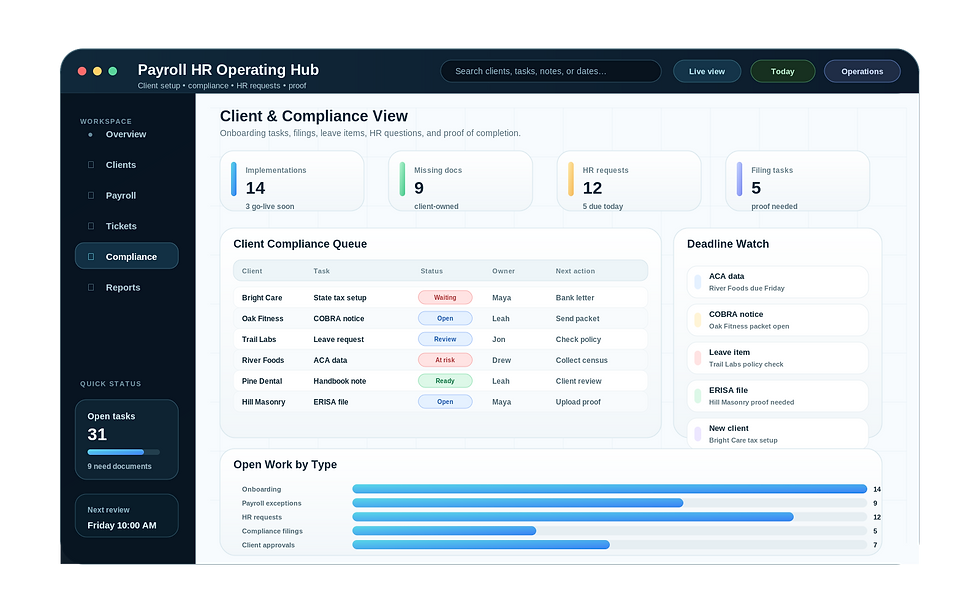
Client & Compliance View
A client-account view for onboarding tasks, employee records, document requests, filings, leave items, ACA, COBRA, ERISA, HR questions, and proof of completion. The goal is clearer service ownership across recurring and advisory work.
Service Revenue Intelligence
Revenue, workload, ticket, payroll-cycle, advisory, response-time, and client-health visibility for payroll and HR consulting owners. The view shows bottlenecks, risky accounts, recurring issues, and practical next actions.

Made for Payroll and HR Service Work
Payroll and HR consulting work happens across client calls, employee files, cutoff dates, compliance tasks, support tickets, and account reviews. The system needs to work on desktops, tablets, and phones so staff can update the right record while managers keep sensitive work moving.

