

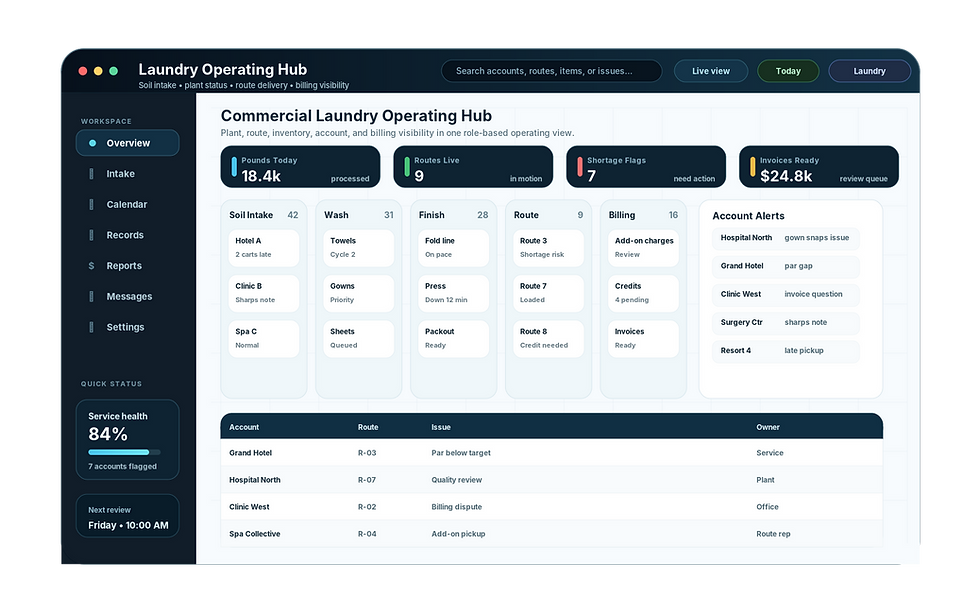
Connect soil intake, plant status, route delivery, shortages, and billing so managers know what came in, what moved out, and what still needs action.
See Every Pound
Give route reps clear stops, service notes, issue logs, proof of service, and account exceptions so missed deliveries and repeated complaints drop.
Control Route Gaps
Track par levels, loss, textile life, rewash, repairs, and customer usage patterns so linen shortages and replacement costs are easier to control.
Protect Linen Stock
Tie pickups, deliveries, add-ons, credits, shortages, and exceptions to billing triggers so missed charges and disputed invoices are easier to catch.
Stop Billing Leaks


Systems Customized to Meet Your Needs
Our systems are developed around the way commercial laundry, plant production, route service, account issues, and billing actually work together:
Marketing & Visibility - Clarify service areas, account types, industries served, contract value, reliability proof, and service promises.
Lead Capture & Intake - Capture account details, site locations, pickup needs, par levels, item types, delivery windows, and issue history.
Quote & Approval Flow - Manage proposals, contract terms, service changes, credits, add-ons, billing rules, and account approvals.
Route & Service Scheduling - Assign pickup and delivery routes by site, stop sequence, delivery window, account needs, and capacity.
Route and Plant Execution - Give plant teams and route reps soil intake, load, quality, delivery, proof-of-service, and exception steps.
Customer Communication - Send service updates, shortage notices, issue responses, account reports, invoice notes, and escalation follow-up.
Service History & Retention - Track account history, par levels, losses, complaints, renewals, service changes, and recurring route work.
Reviews & Reporting - Track fill rates, delivery proof, rewash, shortages, billing exceptions, route rep performance, and account profitability.
Top Ten Points of Failure for Commercial Laundry / Linen Route Systems
1. Fragmented order, plant, route, and billing workflows
Owners say the handoff from order entry to soil intake, production, dispatch, delivery, and invoicing often breaks across separate tools, emails, and paper notes. When the chain is not connected, teams lose track of what came in, what was shorted, and what should be billed.
2. Route service built on tribal knowledge
Trade research and managers indicate that route reps often carry account rules in their heads. If five routes use five different service habits, the customer experiences five versions of the company and training new reps becomes much harder.
3. Billing errors and weak proof of service
Public complaints in the research point to billing for service not received, continued charges after cancellation, missed deliveries, and weak follow-through. Route businesses need stronger proof, exception notes, credits, and billing triggers before disputes reach collections.
4. Poor par-level and linen inventory visibility
Managers indicate that par-level discipline, textile life, loss, and replacement costs shape both service quality and margin. Without better site-level visibility, shortages, overuse, wash frequency, and replacement needs become expensive surprises.
5. Quality defects that feel like service failure
Buyers complain about stains, tears, poor quality, missing goods, and inconsistent follow-through. Operators say errors in soil sort and weak quality checks get more costly downstream, especially when damaged linen reaches nurses, hotel staff, or facility teams.
6. Labor strain and inconsistent plant productivity
Operators report staffing shortages, wage pressure, burnout, and strong interest in automation, even when capital cost delays decisions. Managers need workflow visibility that makes labor gaps, bottlenecks, and training needs visible before the backlog grows.
7. Demand spikes and capacity blind spots
Hospital, hotel, and hospitality accounts can create 24/7 demand, seasonal peaks, and high-volume days. When plant capacity, equipment status, routes, and account priority are not visible together, a single bottleneck can turn into missed delivery windows.
8. Equipment downtime and weak recovery planning
Operators say machine downtime can quickly create unprocessed linen backlogs. Without preventive maintenance visibility, backup-provider plans, and escalation rules, one equipment failure can pressure labor, routes, customers, and billing at the same time.
9. Compliance, hygiene, and safety exposure
Sensitive accounts need evidence-backed process discipline around contaminated laundry, sharps, containment, labeling, and safe handling. Weak documentation and inconsistent work practices raise risk beyond ordinary service complaints.
10. Thin KPI rhythm by route, account, and route rep
Trade guidance points to weekly reviews by route, customer segment, and route service rep. Without a steady KPI cadence, managers miss patterns in shortages, billing leakage, complaints, service recovery, usage, and account profitability.
Here's How We Address These Issues

Account Intake
-
Captures account type, locations, contacts, delivery windows, item needs, and par levels
-
Records contract terms, service frequency, billing rules, and special site requirements
-
Separates new accounts, service changes, shortages, credits, pickups, and complaints
-
Flags missing site details, account approvals, hygiene needs, and high-risk service gaps
-
Gives office, route, and plant teams a cleaner account record before service begins

Route Accountability
-
Centralizes stops, route reps, pickup/drop schedules, account notes, and exceptions
-
Shows what is scheduled, loaded, delivered, shorted, delayed, credited, or escalated
-
Connects delivery proof, site contacts, route issues, and customer communication
-
Reduces dependence on paper notes, emails, memory, and disconnected dispatch habits
-
Gives managers clearer visibility by route, rep, account, and service day

Plant and Quality Flow
-
Gives production teams soil intake, sort, wash, finishing, packout, and load steps
-
Supports quality checks for stains, tears, rewash, repairs, shortages, and missing goods
-
Tracks demand, labor, equipment status, and route deadlines in one operating rhythm
-
Builds QA checkpoints into the work before defects become customer complaints
-
Helps prevent downstream errors that cost more to fix after delivery

Billing and Service Proof
-
Tracks pickups, deliveries, add-ons, credits, shortages, service changes, and approvals
-
Documents proof of service before invoices, credits, or disputes move forward
-
Connects route exceptions to the account, invoice, contact, and next required action
-
Reduces missed charges, duplicate billing, cancellation confusion, and collection issues
-
Maximizes margins while making account communication clearer and calmer

Linen Inventory Control
-
Stores item types, par levels, loss notes, textile life, and replacement indicators
-
Triggers review needs for chronic shortages, overuse, missing goods, and account misuse
-
Supports customer education around usage, par discipline, losses, and service options
-
Helps convert complaints into clearer account planning and service recovery
-
Improves customer experience through timely, specific inventory communication

Account Growth Backbone
-
Connects sales, account onboarding, route service, plant operations, and reporting
-
Supports route rep onboarding, SOPs, coaching, and service standard consistency
-
Keeps tools practical, role-based, and fitted to route and plant work
-
Tracks fill rates, route performance, complaints, credits, renewals, and account value
-
Creates a system that can support more accounts, routes, sites, and service volume
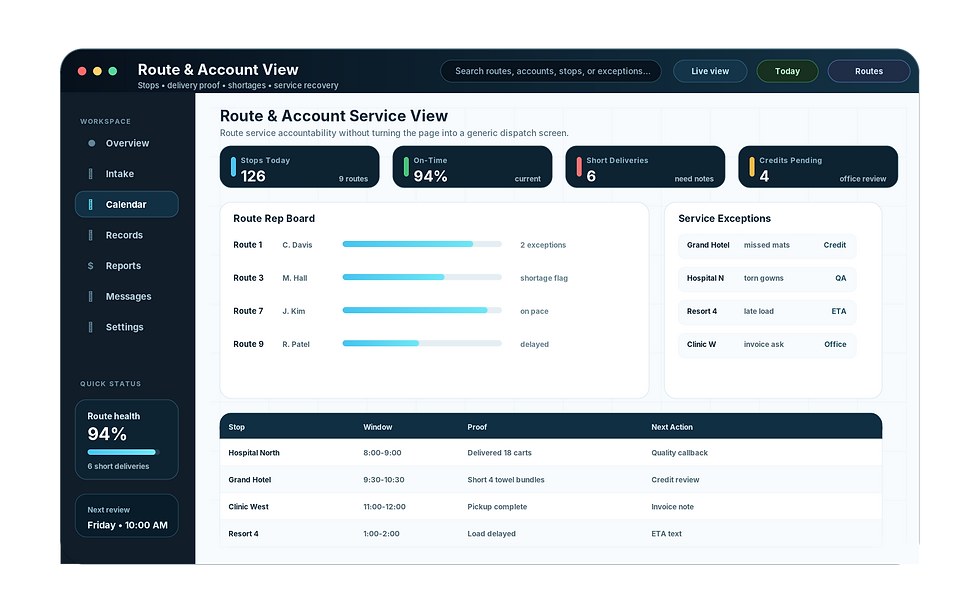
Route & Account View
Route and account visibility for stops, pickup/drop schedules, delivery windows, load status, proof of service, shortages, credits, and customer issues. Managers can see what is on route, what was delivered, and what needs escalation.
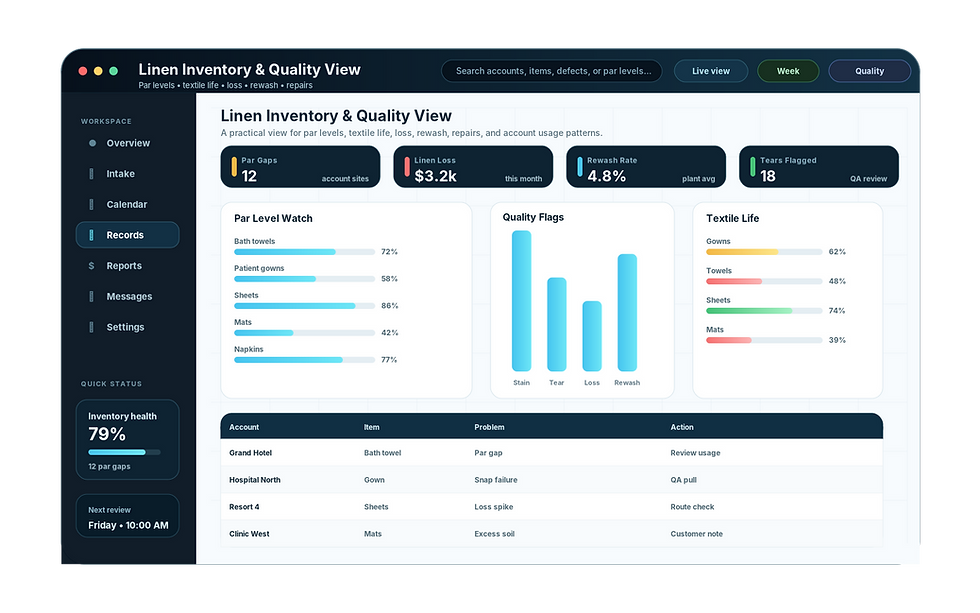
Linen Inventory & Quality View
A control view for par levels, item categories, textile life, loss, stains, tears, rewash, repairs, packout, and account usage patterns. It helps managers spot shortages and quality issues before they become repeat customer complaints.
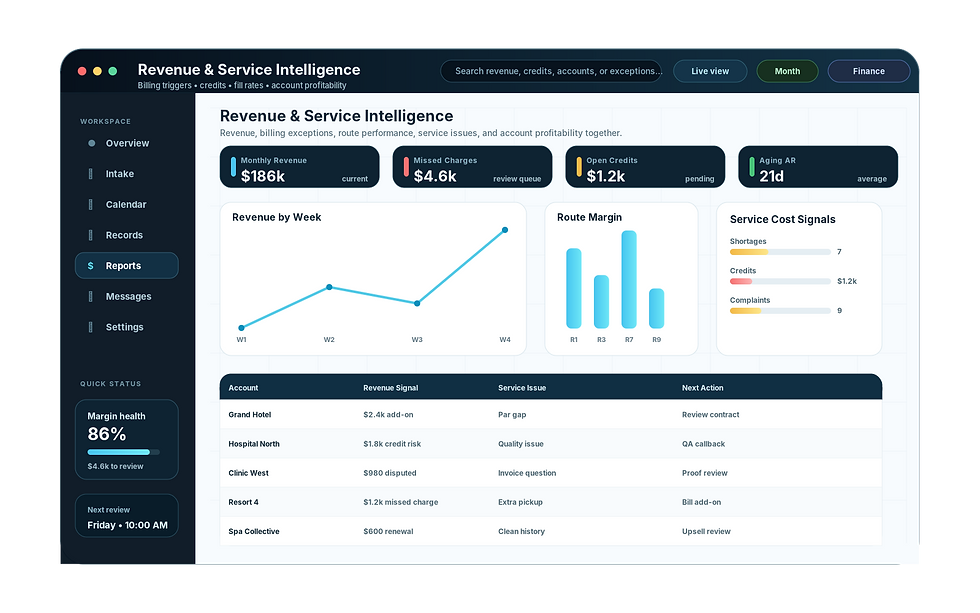
Revenue & Service Intelligence
Revenue, route performance, billing triggers, credits, missed charges, customer complaints, fill rates, labor pressure, and account profitability visibility. The view shows where service gaps are costing margin or trust.
Made for Route and Plant Work
Laundry service happens across account sites, trucks, soil intake, plant production, quality checks, delivery proof, and office billing. The system needs to work on phones, tablets, and desktops so route reps, plant teams, and managers can keep the service chain visible.

