

Tie each appointment to model data, vendor status, truck stock, and job readiness so return visits are scheduled only when the repair can move that day.
Parts-Ready Work
Capture appliance type, brand, model, serial, photos, symptoms, prior visits, and billing notes in one record the office and technicians can trust.
Model-Serial Clarity
Build deposits, diagnostic fees, payment links, and collect-before-close rules into the workflow so repair revenue does not sit unpaid after service.
Cleaner COD Flow
Give technicians better prep, parts visibility, and repair notes before arrival so the business improves first-time-fix performance on real jobs.
Fewer Repeat Trips


Systems Customized to Meet Your Needs
Your system is built around the full appliance repair journey:
Lead Sources & Visibility — Connect website, Google, referral, marketplace, and phone leads into one qualified intake path.
Appliance Intake & Qualification — Capture customer, appliance type, brand, model, serial, symptoms, photos, service area, and payment readiness.
Estimate & Authorization Flow — Manage diagnostics, written estimates, approvals, deposits, repair authorizations, and invoices.
Scheduling & Parts Readiness — Assign appointments by technician, location, appliance type, vendor status, truck stock, and readiness.
Field Diagnostics & Repair Workflow — Give technicians job notes, model data, checklists, photos, status steps, and closeout requirements.
Customer Communication — Send confirmations, ETAs, parts-delay updates, approvals, invoices, payment links, and review requests.
Appliance History & Retention — Track prior visits, installed parts, warranties, declined work, callbacks, and repeat-service opportunities.
Reviews & Reporting — Monitor lead sources, booking quality, first-time-fix performance, collections, warranty status, and reputation trends.
Top Ten Points of Failure for Appliance Repair Systems
1. Return visits scheduled before parts are in hand
Owners and technicians repeatedly indicate that projected delivery dates create broken promises when dispatch schedules a return visit before the part is physically on the truck, received, or verified.
2. Generic records that miss the appliance itself
Owners say normal customer records are not enough for repair work. The system has to keep appliance type, brand, model, serial, photos, symptoms, notes, prior visits, and billing history together.
3. Multi-visit jobs losing the thread
Managers indicate that diagnosis, parts ordering, return scheduling, repair completion, and occasional sales follow-up often split across texts, calendars, invoices, and memory.
4. Weak COD, deposit, and collection controls
Owner accounts repeatedly describe stale invoices and payment stress. Appliance repair needs diagnostic fees, deposits, stored cards, and collect-before-close rules built into the job flow.
5. Office-to-field communication gaps
Customers often blame the technician when the office gives an ETA, parts update, or appointment status that the field team cannot support. That gap creates callbacks, reschedules, and review risk.
6. Truck stock and vendor status blind spots
Repair teams lose margin when common parts are missing, wrong parts are ordered, or parts sit unused on the shelf. Parts readiness has to connect directly to scheduling decisions.
7. Loose estimates and authorization records
Customer complaints often form around unclear estimates, surprise charges, repeat fees, or work performed without clean approval. Written estimate and authorization trails protect trust and margin.
8. Lead flow that creates unqualified work
Owners report expensive Google leads, ranking pressure, and time wasted on calls outside the service area. More lead volume helps only when intake screens for job fit and capacity.
9. Inconsistent diagnostics and technician development
Managers say newer technicians can be intimidated by electronics, schematics, connected appliances, and customer-facing pressure. Weak notes and training turn that pressure into recalls.
10. Warranty work draining time and margin
Warranty-heavy operators describe claim denials, low reimbursement, pricing scrutiny, and administrative fights. Those jobs need separate tracking, proof, pricing rules, and partner-level reporting.
Here's How We Address These Issues

Appliance-Specific Intake
-
Screens service area, appliance type, brand, model, serial, symptoms, and job fit before booking
-
Captures photos, access notes, warranty status, billing preference, and urgency early
-
Separates COD, warranty, authorized-service, and estimate-only requests
-
Routes repair, diagnostic, callback, and parts-return visits differently
-
Reduces weak bookings, missing details, wrong expectations, and wasted trips

Parts-Ready Dispatch
-
Centralizes appointments, technician assignments, appliance records, and parts status
-
Shows what is diagnosed, quoted, approved, waiting on parts, ready, scheduled, or complete
-
Connects vendor status, truck stock, technician skill, and customer timing
-
Prevents return visits from being scheduled before parts are verified
-
Gives owners and office staff clearer control without constant check-ins

Field Diagnostics
-
Gives technicians mobile steps by appliance type and job stage
-
Supports quick status updates from diagnosis through closeout
-
Standardizes symptoms, fault notes, photos, tests, parts used, and repair documentation
-
Adds QA checkpoints for authorizations, customer notes, and completion proof
-
Helps reduce missed details, repeat visits, recalls, and inconsistent workmanship

Estimate & Payment Control
-
Creates cleaner diagnostic fee, estimate, authorization, deposit, and invoice records
-
Tracks COD, stored-card, warranty, and account billing requirements
-
Documents customer approval before work begins, parts are ordered, or scope changes
-
Reduces unpaid invoices, billing confusion, and estimate disputes
-
Protects margin while making charges easier for customers to understand

Customer Trust Loop
-
Stores customer, appliance, repair, parts, warranty, and callback history
-
Sends confirmations, ETA changes, parts-delay notices, invoices, and payment links
-
Supports review requests after completed work and issue recovery after delays
-
Helps turn one-time repairs into repeat customers and referrals
-
Improves service clarity while reducing unnecessary inbound calls

Growth & Warranty Control
-
Clarifies service areas, appliance types, lead sources, and booking rules
-
Tracks which leads, job types, warranties, and partners produce profitable work
-
Supports hiring, onboarding, technician accountability, and diagnostic standards
-
Keeps tools practical, mobile-friendly, and fitted to small repair teams
-
Creates a system that can support more jobs, technicians, and service areas

Appointment Live View
Live appointment and route visibility for technicians, service addresses, ETA windows, job readiness, and parts holds, so returns are not booked before parts are confirmed.

Parts & Readiness View
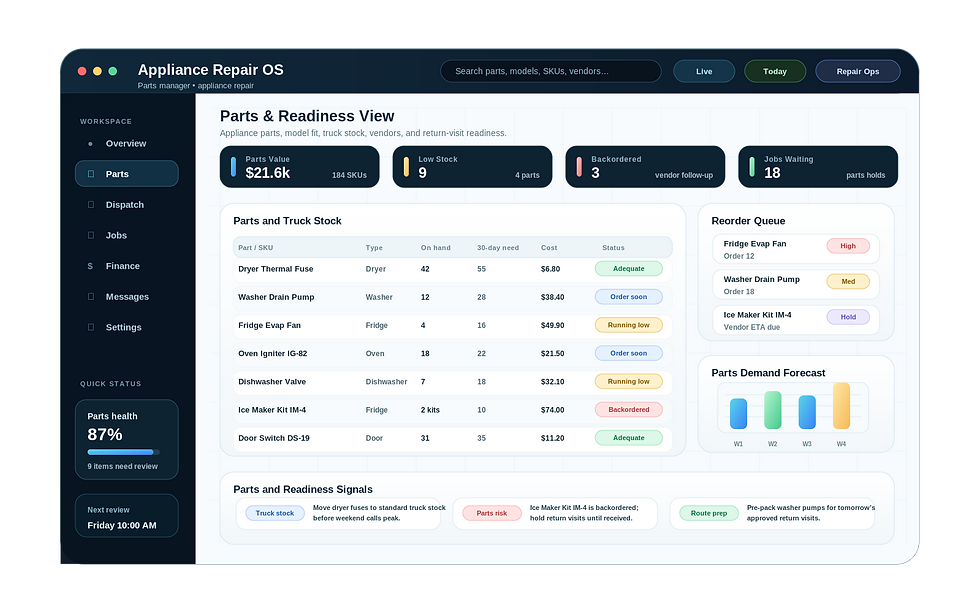
Track appliance parts, truck stock, vendor status, model fit, reorder needs, and return-visit readiness. Optional barcode scanning can support cleaner parts movement.
Repair Margin Intelligence
See diagnostics, COD repairs, warranty claims, parts cost, open invoices, and job margin in one owner view. Find unpaid work, weak job types, warranty drag, and margin leaks earlier.


